
The Hub blog
Bitcoin: how should we classify it? What is its nature?
A currency? Really?
We published this digital humanities article 2 years ago as part of a broader piece of work with the Medium account BlockExplorers https://medium.com/@BlockExplorers. However, at the end of 2020, following a market rally resembling that of 2017, questions about the nature of Bitcoin remain just as topical.
Bitcoin is generally defined as a virtual currency circulating on the internet.
But can we really call it a currency? Does Bitcoin really fulfil the functions of one? Aren’t we now facing a financial asset whose performance could be compared with that of other assets, such as gold?
Or, on the contrary, could it be a class of financial asset unknown until now?
Let’s try to see more clearly…
“Bitcoin is a currency!” Yes, but..
But what exactly is a currency? It’s worth going back to the definition of currency as found on Wikipedia: “currency is defined by Aristotle through three functions: unit of account, store of value and medium of exchange”. Let’s start with the unit of account. Bitcoin does indeed make it possible to measure the value of a good or service and can be stored for future use. We can, for example, determine that a painting is worth 2 or 3 bitcoin; there’s no limit to the goods that can be measured in bitcoin. On this first characteristic, there is no particular debate: this function is fulfilled.
A medium of exchange, since it can be used to buy goods or services. In theory, any type of good or service could be bought in Bitcoin. It’s also a store of value: it can be stored to be used in the future. If we stopped there, we could easily conclude that Bitcoin is a currency like any other.
However, if we look at the precise definition of these last two functions, we can map out Bitcoin’s limits as a currency.
Wikipedia defines a currency’s function as a medium of exchange as follows: “Currency makes it possible to escape the limitations of barter by constituting a value exchangeable for goods and services insofar as the other actors in the economy also accept it”. On this last point, Bitcoin doesn’t fully qualify, because it is not legal tender — that is, recognised by public authorities in such a way that, in a country or zone (Europe, for example), all merchants would be obliged to accept payment in Bitcoin.
For example, the euro is legal tender: in France, article R.642-3 of the Criminal Code penalises refusing to accept notes and coins denominated in this currency. The notion of store of value is also open to debate. By this we mean “the capacity of a financial or real instrument to transfer purchasing power over time.” (source: Wikipedia). To transfer purchasing power into the future, you need to guarantee that it will still exist then and that its value will remain roughly constant.
Yet Bitcoin is highly volatile because it rests exclusively on the principle of supply and demand, being regulated by no body, central bank or state, unlike currencies such as the euro or the dollar. For example, if the euro gains or loses too much value, the European Central Bank steps in to regulate its fluctuations. And throughout its history, Bitcoin has experienced sudden falls in its price, over very short periods. For example, on 30 November 2013 its value was $1,150.73, falling to $547.53 on 18 December, barely a fortnight later. This fall followed a loss of confidence among savers (mainly Chinese) after a note from the Chinese central bank refused to give Bitcoin legal tender status and warned that investing in Bitcoin was a choice made at one’s own risk (Los Angeles Times article). Sharp price swings can also follow speculative bubbles: for example, a fall of more than 60% occurred on 12 April 2013.
More recently, the same phenomenon occurred with a depreciation of around 30% in 2 days (from about €2,300 to €1,680) following a very strong bull rally in April and May 2017.
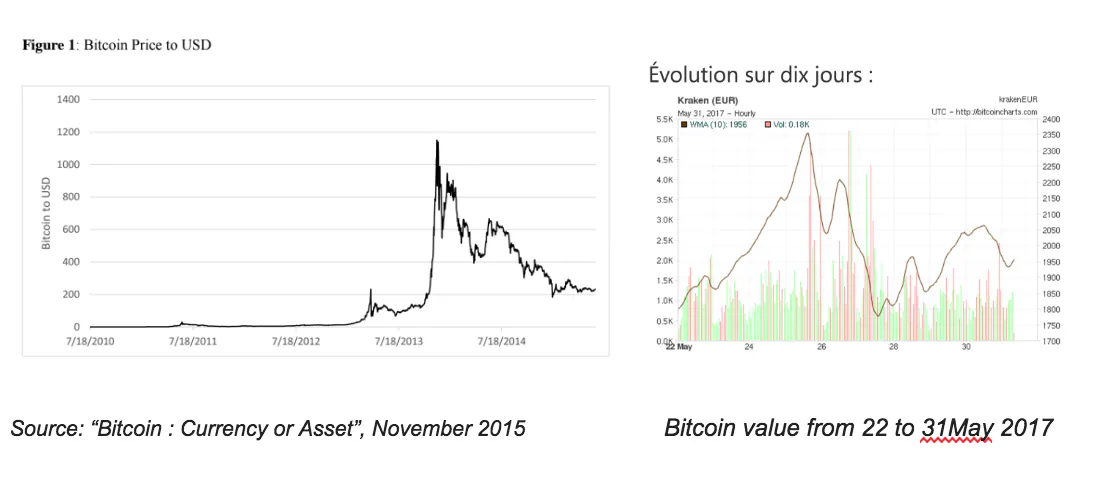
Bitcoin therefore doesn’t fully fulfil the 3 functions specific to currency.
The other function that can characterise currency is being a means of payment. Alain Testart, a French anthropologist, in his book “Aux origines de la monnaie” (2001), even defined it as the most important function, above even the more commonly accepted one of “medium of exchange”.
A means of payment? Technically yes, in practice hardly
To get an idea of the notion of a means of payment, several elements seem worth looking at to us. Where do we pay in Bitcoin? What are the transaction volumes compared with other means of payment used? What is the user profile of people who own Bitcoins?
You can consult the website www.coinmap.org, created in 2013 by Satoshilabs, where you can get an idea of the countries where physical sales with this currency take place. This site isn’t necessarily exhaustive because it relies on self-reporting (one might indeed wonder why Africa, and Nigeria in particular, is so under-represented), but it shows that it is possible to pay in Bitcoins in the physical world, and pretty much all over the world.
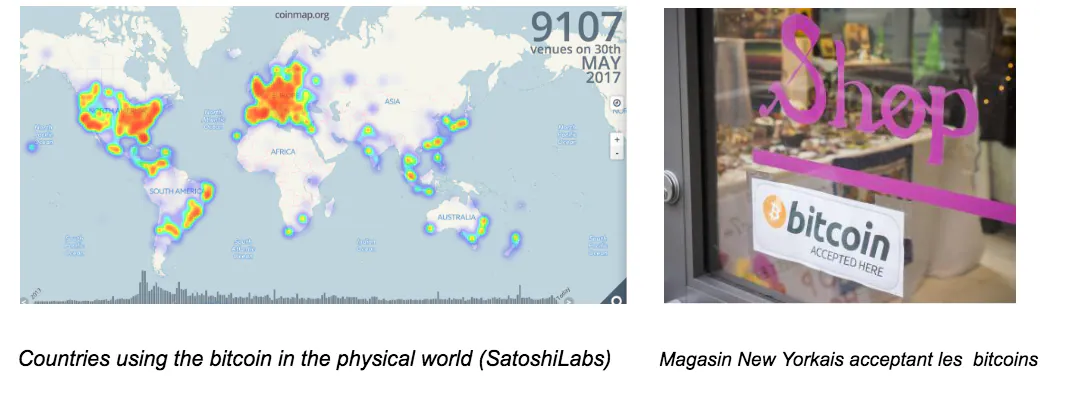
Japan, for its part, is developing its use. While to date 4,500 shops accept payment in Bitcoins, this will soon concern 260,000 retailers across the archipelago, as Numerama explained in its article of 6 April. For more information on the subject, you can read the article here: Bitcoin Payment Makes Way To Japanese Retailers, PYMTS.com 30 May17 . Recently, a Japanese airline even began offering its customers the option of paying for their plane tickets in bitcoin: Peach Airline to Accept Bitcoin After Japan Recognizes Cryptocurrency
As for its use in the digital world, it isn’t limited to the darknet, as the image recently conveyed by the media might suggest. It is also possible to pay in bitcoin on e-commerce sites. The French site bitcoin.fr can give you a quick, non-exhaustive overview (https://bitcoin.fr/depenser-ses-bitcoins).
One of the limits to using “Bitcoin” as a means of payment is that users aren’t protected in the event of fraudulent use. Yet this security is an integral part of traditional means of payment (bank cards, for example), and its absence currently limits trust and potentially its adoption by ordinary citizens in their everyday lives.
If our bank card is used fraudulently, banks are obliged to reimburse us; that’s not the case with Bitcoin. Indeed, while the protocol is tamper-proof, Bitcoin exchange platforms can be hacked. This notion of trust is very important in Bitcoin, and the subject will be explored in our third article, “Profile/User”.
So yes, Bitcoin is used as a means of payment, but is its use as such really significant?
The idea would be to look at the current use of Bitcoin by the people who own it.
We can start by looking at daily transaction volumes worldwide and comparing them with other means such as PayPal and bank cards.
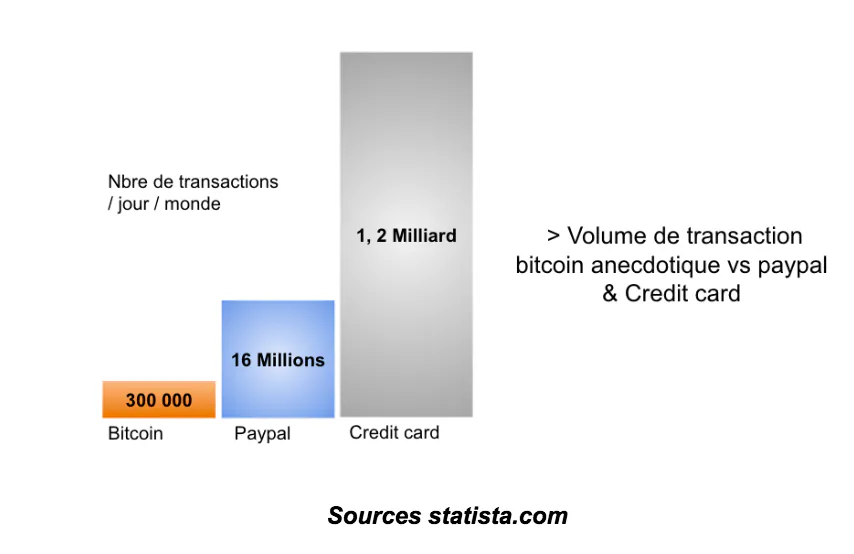
With 300,000 transactions per day compared with 1.2 billion for bank cards, we can consider the volume linked to Bitcoin to be anecdotal for the time being. But do the people who own it really use it as a means of payment? Here, the study “Bitcoin: currency or asset?”, published in November 2015, sheds light on the question. We will in fact rely on it heavily throughout this article. It distinguishes investors (active investor and receive only investor), who buy Bitcoins with the intention of speculating or investing, from those who use it as a “currency” (currency user), to buy goods and services.
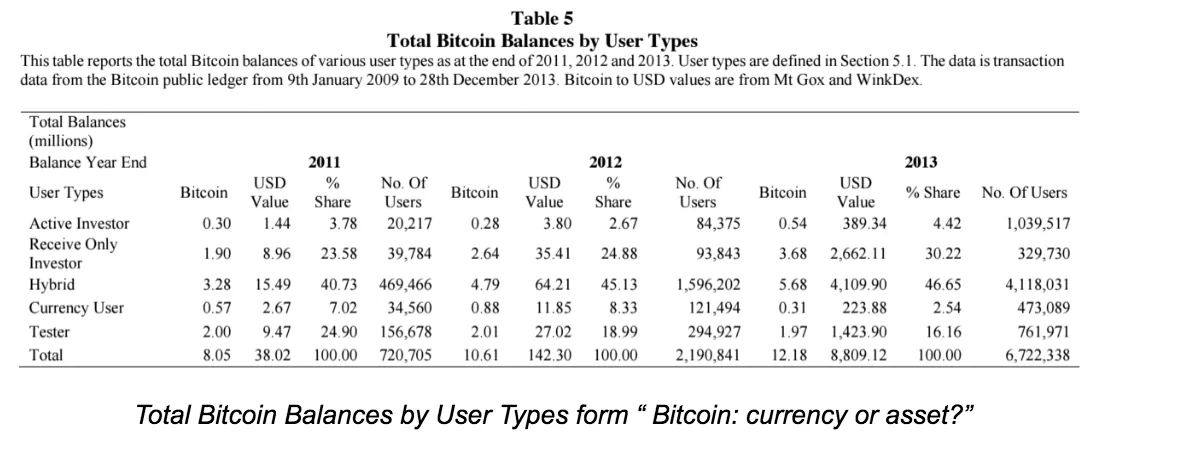
Between 2011 and 2013, the authors observe that while the share of “investors” in the population using Bitcoin rose from 27.36% to 34.62%, the share of “currency users” went from 7.02% to 2.54%, which represents a significant decline. The study concludes that, for the majority of those who own it, Bitcoin is now considered more a financial asset than a means of payment.
So Bitcoin is above all a financial asset: but what kind?
We might ask whether it isn’t a speculative financial product more than an investment product. To find out, we can look at its volatility, which we calculated from the daily price values between October 2011 and April 2017.
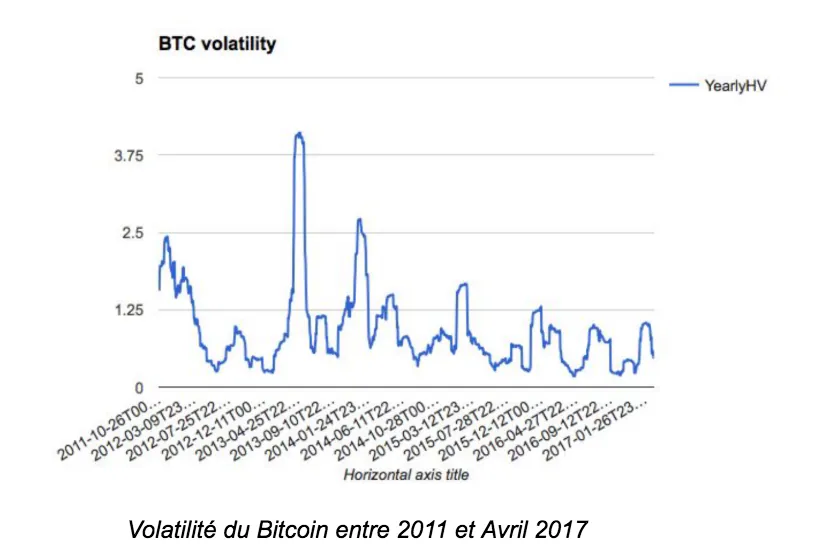
We note that while its volatility was extremely high in its early days, it has tended to stabilise since 2015. We might therefore conclude that Bitcoin is becoming less and less speculative. However, if we compare this volatility index with that of other assets — work carried out in “Bitcoin: Currency or Asset?” — Bitcoin’s volatility remains extremely high compared with the other assets studied.
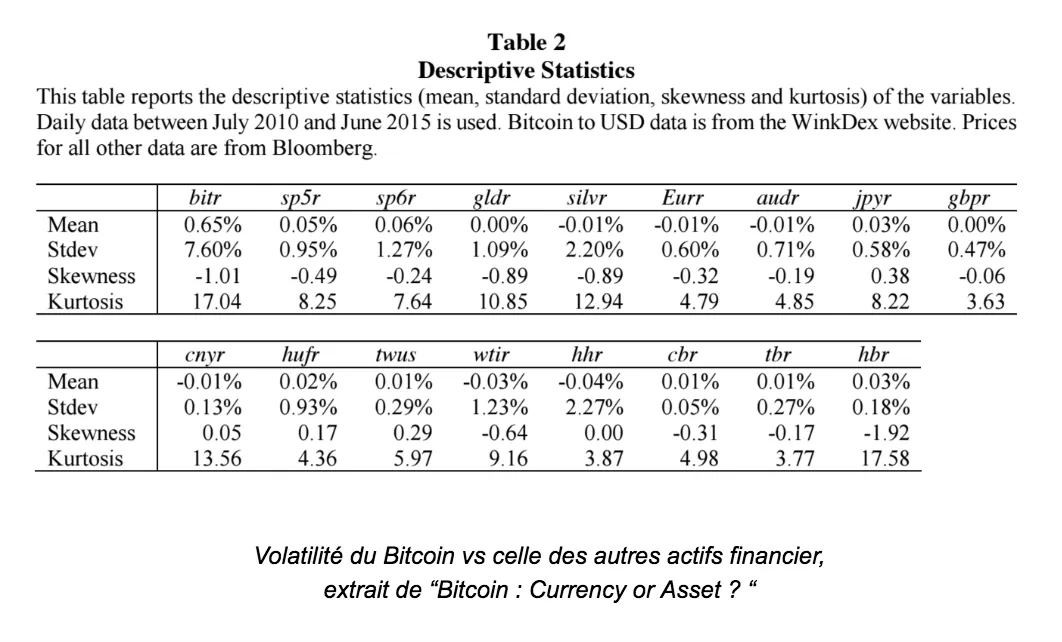
This asset therefore has strong speculative characteristics, but not only that, and this seems to be changing. So it isn’t enough to characterise it as a speculative product.
Is Bitcoin a safe haven?
Recent media attention seems focused on the financial performance of this “digital gold”, which breaks record after record every week: has Bitcoin become a safe-haven asset?
But first of all, what do we mean by a safe haven?
A safe-haven asset is, in theory, one that fluctuates less than its base index, therefore has low volatility and so offers more security. Some shares are safe havens, as are currencies (notably the USD and the Swiss franc) or gold, which has historically been considered the safe haven par excellence.
The notion of a safe haven can be assessed from a behavioural point of view, that is, investors’ tendency to take refuge in it during negative movements in other assets (such as listed assets like shares). It’s mainly in this sense that gold is considered a safe haven, rather than because of its volatility, which is far from low and which, if we considered it on that criterion alone, would not make it a “safe-haven” type of asset.
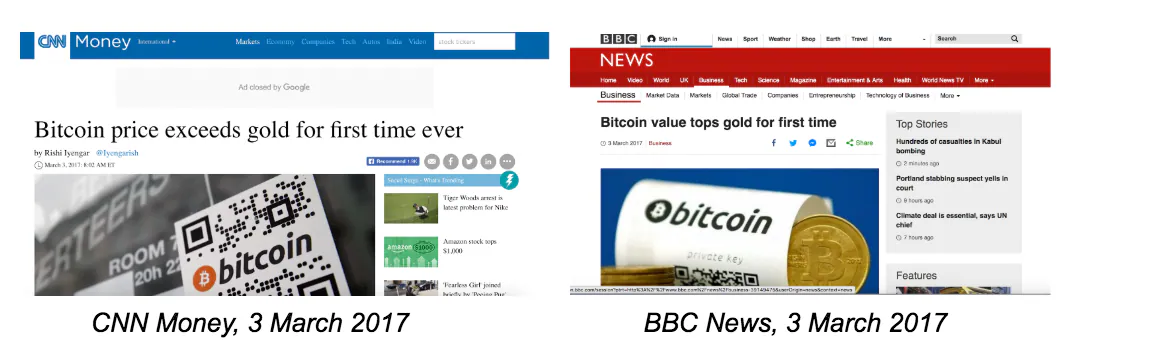
This notion of a safe haven has been raised all the more since the price of Bitcoin rose above that of an ounce of gold for the first time on 2 March 2017.
One of the first analyses consists of looking at the correlation between changes in the bitcoin price (between 2011 and 2017) and other financial assets, namely shares (Nasdaq, S&P 500), the dollar, the euro, commodity prices (iShares Commodities) and, of course, gold. According to the study “Bitcoin: currency or asset?”, there is no particular correlation between Bitcoin and the other assets studied.
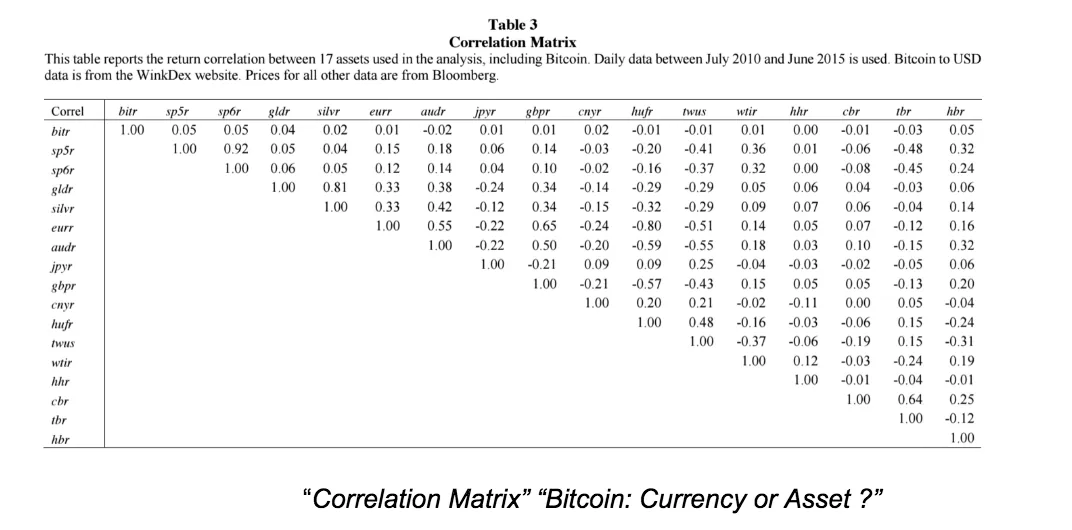
If it were a safe haven, it should have behaved similarly to gold, particularly at critical moments on the stock markets. Gold is known for reacting in the opposite direction to the markets when the situation becomes tense.
With this in mind, we can look at the start of the Chinese financial crisis in early January 2016, following the government’s depreciation of the Chinese currency, which came after the mini stock-market crash in China in summer 2015 Le Monde article, January 2016.
This mini crash rippled through the European and American markets for a few weeks. The idea was therefore first to look, on this specific example, at whether Western and Chinese platforms showed immediate safe-haven behaviour like gold.
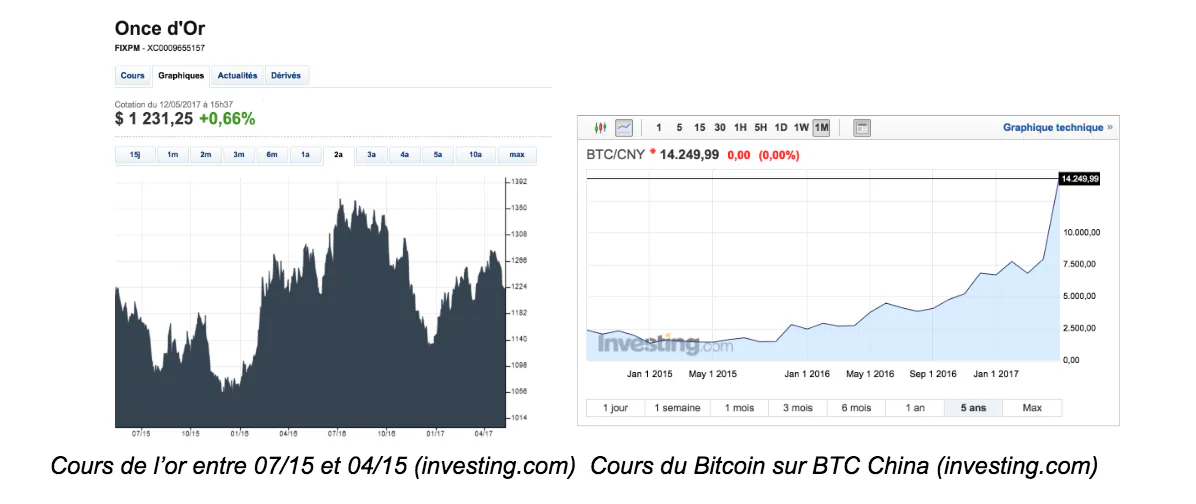
We note that there was no particular surge in Bitcoin during this period, unlike gold, which played the role of an immediate safe haven.
The study “Bitcoin: Currency or asset?” carried out this type of exercise in greater depth, over a longer period, comparing Bitcoin’s behaviour with that of the S&P 500 to see whether “safe-haven” behaviour could be observed in reaction to negative movements in US listed shares, namely the S&P 500.
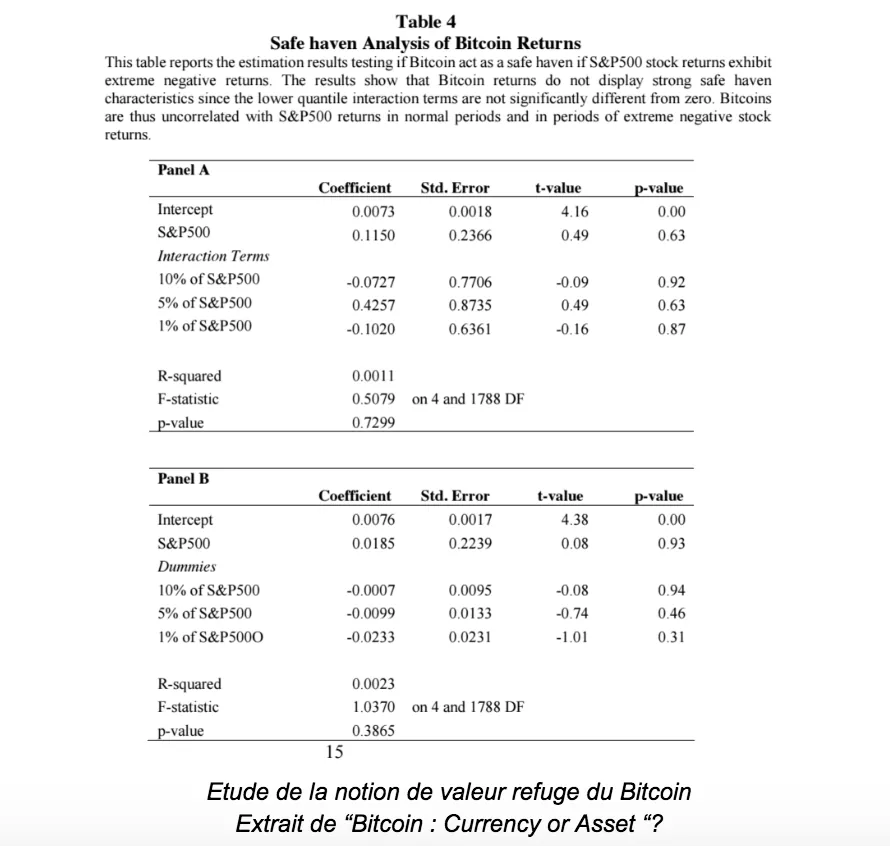
The study finds no inverse relationship between the S&P 500 and the Bitcoin price, meaning that even during a sharp fall in the S&P 500, Bitcoin offers investors no systematic protection.
Contrary to popular belief, then, we can’t really call it a safe haven.
Bitcoin is above all an unidentifiable asset… and constantly evolving
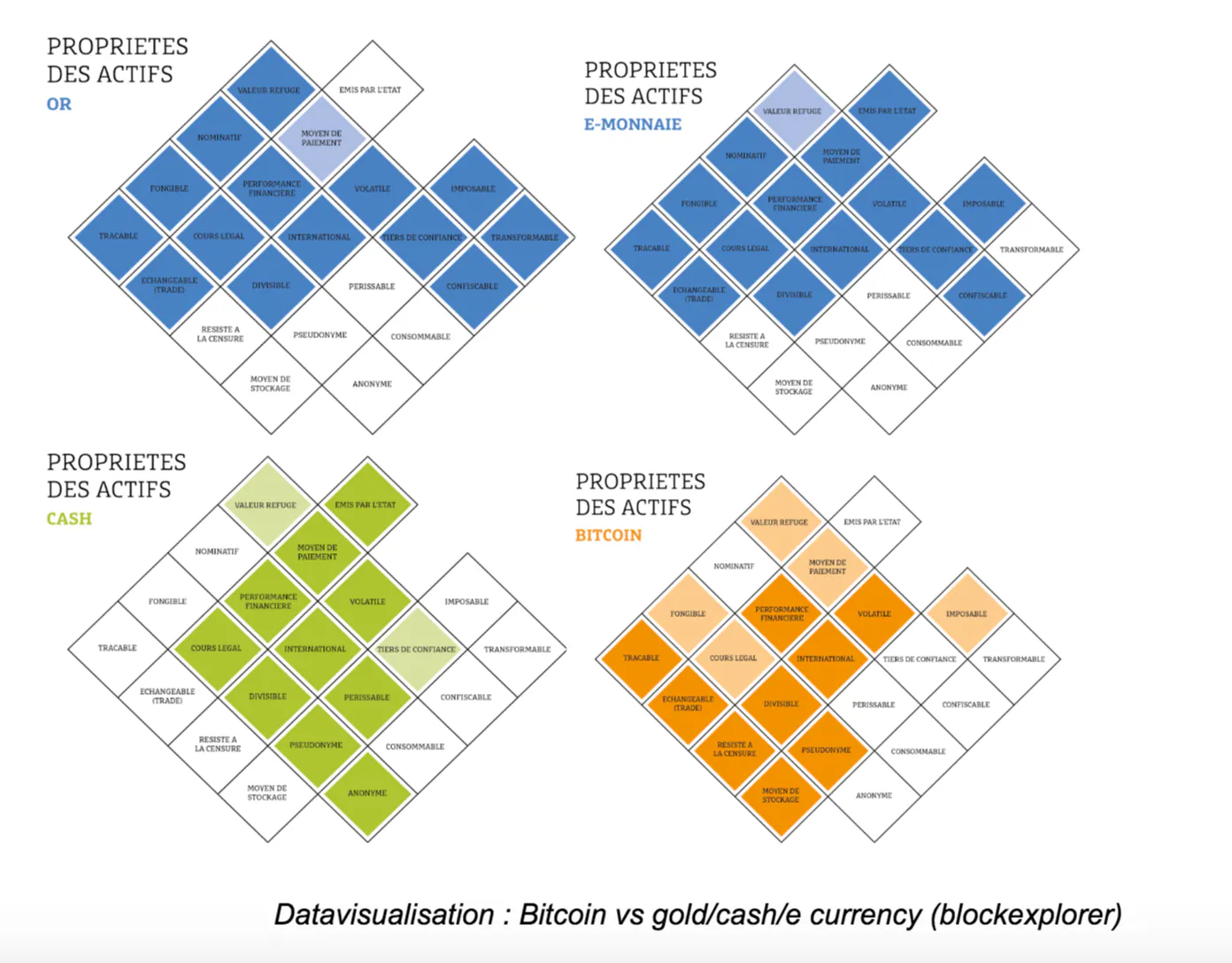
While Bitcoin, to date, seems closer to a financial asset than to a currency, it resembles no known asset. The data visualisation we published previously (see our article “Visualizing Bitcoin”) shows that it doesn’t fit into any box and has its own representation.
Certain characteristics (legal tender, means of payment, for example) are not set in stone and could define it in the future, depending on the position that states or financial institutions take on this new asset, bringing it closer to other well-identified ones.
But what will become of the libertarian ideals that gave birth to this currency, with the desire to create an alternative to our financial system, if its general adoption comes from recognition by the very states and financial institutions it claims to free itself from? Especially if the “legalisation” of this currency is intended to control it better?
Paradoxical, isn’t it?
Won’t these ideals then move entirely to another cryptocurrency that will take Bitcoin’s place, until that cryptocurrency is itself legalised and then replaced? Cryptocurrencies would then be destined to be “ephemeral” currencies playing the role of cash — which, by the will of states, will eventually have disappeared — an electronic cash: in other words, an instrument of protest in societies of control.
And what do you think?
A short Bloomberg video from 26 May 2017.
This article isn’t a digital marketing or digital strategy article; rather, it echoes the digital humanities, namely understanding how our society is evolving with the web and grasping the main issues at stake.
Reference and sources:
How to position for the rally in Bitcoin, November 2015, Adamant Research
Virtual currency tangible Returns,
Bitcoin ringing The Bell for a new asset, January 2017, Chris Burniske, ARK Invest, Adam White, COINBASE
Does BTC improve portefolio diversification, 3 June 2015, Stephan Gasser, EPub Institutional Repository
Bitcoin Currency or Asset, November 2015, Dirk G Baur, Kühne Logistics University, KiHoonKong, Hongik University of College of Business, Adrian D Lee, UTS Business School
“Peech Aviation accepte les paiements de réservation en Bitcoin”: Link to the Le Point article, 22 May 2017
“Bitcoin, Bienvenue dans la 3ème bulle”, 18 May 2017 http://la-chronique-agora.com/bitcoin-bulle/
https://bitcoincharts.com/charts/volumepie/
Aux origines de la monnaie, Alain Testart, 2001