Design thinking
Ready to transform your creative process and lead innovative projects to success? Design thinking is most likely the method you need. Whether you’re an entrepreneur, a business leader or a designer, design thinking lets you take a human-centred approach to solving your problems and sparking innovation.
Start my project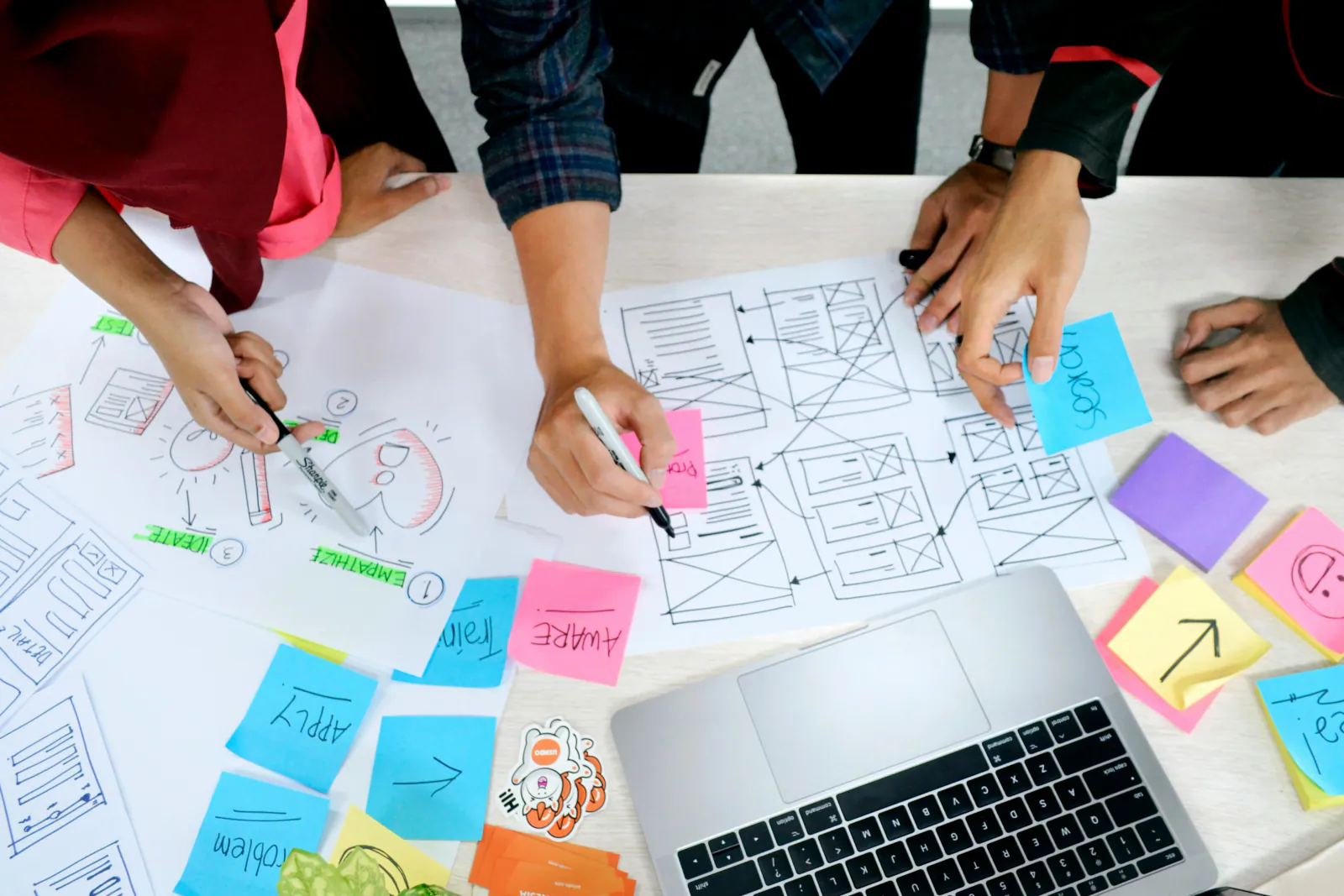
What is design thinking?
Design thinking is a creative, iterative approach that puts users’ needs at the centre of solving complex problems. It’s widely used in design, innovation and project management. Design thinking relies on collaboration, creativity and calculated risk-taking to find novel solutions.
The method rests on a deep understanding of users and their needs. It uses specific tools to generate creative ideas, prototype concepts quickly and test them with the target audience.
Design thinking can be applied to many fields, such as product strategy, solving organisational problems or crafting user experiences.
The stages of design thinking
Design thinking typically includes five key stages, often pictured as a spiral process:
Empathy
This stage is about understanding users’ needs, motivations and challenges. It involves in-depth research, user interviews and observation of their behaviour — the equivalent of a product discovery when developing a new product.
Problem definition
Once you have a deep understanding of the users, you can clearly define the problem to solve. This stage consists of formulating a specific question or challenge to address.
Idea generation
The most fun stage — generating as many creative ideas as possible to solve the identified problem. Encourage divergent thinking and explore every avenue, without holding back.
Prototyping
Once you’ve generated ideas, it’s time to make them tangible as prototypes. Prototypes can take many forms, from a simple sketch to a working model. You can bring in a UX designer if you’re building a digital product.
Testing and iteration
The prototypes are then tested with users to gather feedback, which is used to improve them and iterate on the proposed solutions. This iterative process continues until a satisfying solution is found.
Why the research phase matters
The research phase is an essential stage of design thinking. It’s how you understand the users, their needs and their motivations. Research can take many forms: interviews, observation, surveys or data analysis.
Research gathers the valuable information that will serve as the basis for defining the problem to solve and generating creative ideas. The better you understand the users, the better equipped you are to design solutions that fit their needs.
Note that research isn’t limited to end users. It can also cover the market, the competition and industry trends. Thorough research gives you a global view of the context the problem lives in.
The research phase may feel time-consuming, but it’s essential to design thinking’s success. Deep research leads to the right decisions and to solutions that genuinely answer users’ needs.
Defining the problem to solve
Once your research is done, it’s time to define the problem to solve. Defining the problem focuses the effort on a specific question and keeps you from spreading yourself thin.
The problem definition must be precise and clear. It should describe the challenge in a way that makes it solvable. An effective problem definition guides the design effort and generates relevant ideas.
A good problem statement should be shared by a group of people (your target audience) and be painful enough that end users actively want a solution — and are ready to pay for it.
Once the problem is clearly defined, you can move to the next stage: idea generation.
Generating creative ideas
Idea generation is the stage where you explore different avenues and generate as many creative ideas as possible to solve the identified problem.
To generate creative ideas, encouraging divergent thinking matters: avoid judging ideas too quickly and keep an open, exploratory mindset. The more ideas you have, the better your chances of finding an innovative solution.
Many idea-generation techniques exist: brainstorming, mind mapping, visualisation techniques and role playing. The goal is to stimulate the team’s creativity and help new, original ideas emerge. Surround yourself with people who are motivated to take part — and kind about it.
When generating ideas, lean on the information gathered during the research phase. Ideas should be grounded in a deep understanding of the users and their needs.
Once you’ve generated a large pool of ideas, you can move to the next stage: prototyping and testing.
Prototyping and testing
Prototyping is about turning the generated ideas into tangible prototypes. Prototypes vary depending on the project’s stage of development.
Prototyping brings ideas to life and puts them in front of users. Prototypes are simplified versions of the envisioned solutions, used to gather precious feedback and iterate on the proposed concepts.
Prototype tests can be run with end users or representatives of the target audience. The feedback collected identifies the strengths and weaknesses of the proposed solutions and drives improvements before the final product ships.
Prototyping and testing are iterative stages. It’s often necessary to loop back, adjust the prototypes and test them again. This iterative approach refines the concepts and makes sure the proposed solutions genuinely answer users’ needs.
Iteration and continuous improvement
Iteration is the stage that uses the feedback gathered during testing to improve the prototypes and iterate on the proposed solutions.
During iteration, staying flexible matters. Some ideas or concepts may have to be dropped or reworked based on the feedback received. The goal is to learn from the tests and keep improving the proposed solutions.
Iteration may take several cycles of prototyping, testing and improvement. Each cycle refines the concepts and brings you closer to the final solution.
Note that iteration isn’t limited to the prototyping and testing phase. It applies to every stage of design thinking, including research, problem definition and idea generation. Iteration continuously adjusts and sharpens the design process.
Tailor-made support
Work with digitags’ design thinking experts
Get the support of a design thinking expert to lead the thinking and run the process. At digitags, we’ve built a hub of 1,600+ freelance experts, including seasoned design thinking practitioners. Get in touch to discuss your needs and find the ideal talent for your company.