
The Hub blog
Product Owner VS Project Manager
Product Owner and project manager? It’s the same thing, right? Not quite!
Product Owner? Project Manager? It’s the same thing, right?
In reality, the answer is no! Project manager and Product Owner are two quite distinct jobs.
Many people think the two actually mean the same thing, but that’s not the case.
There are certainly some similarities, but the two positions require very specific skills and values.
Today, I’m going to introduce the jobs of product owner and project manager, as well as the main differences between the two.
If that interests you, read on! Enjoy :)
What is a project manager?

A project manager is the person responsible for making sure a project (or the projects in their charge) runs smoothly. They are both a leader and a manager.
Their role is therefore to deliver the project on time, while respecting the various budget limits and deadlines they have been set.
The project manager must organise and plan resources effectively for each of the activities.
For example, the three phases of project management are as follows:
· Define: the objectives are defined and set. You also need to think about budget limits, resources and deadlines. It’s also the moment to identify the stakeholders and draw up the specifications.
· Plan: this step is essential. This is when you need to write your documentation. It will serve to record how you want to develop the project, taking into account the various deadlines and the specifications. The project manager must respect the specifications.
· Implement: you will use the documentation written in the “Plan” phase to control the project’s implementation.
It is essential that project managers know and understand the technical details of the project, so they can help the teams if problems arise. However, the project manager steers but does not handle the operational delivery.
If the client changes their mind on certain points, the project manager must be able to re-plan the project and adjust its implementation with the help of their teams.
The project manager must therefore be able to adapt quickly when obstacles appear.
What is their role?
In addition, the project manager has many day-to-day tasks and responsibilities:
· Managing the organisation of the project,
· Tracking and measuring the progress of the project and the team,
· Handling the administrative side of the project,
· Identifying potential project risks,
· Creating and updating project documentation,
· Managing the unexpected (time, budget, etc.),
· Delivering a profitable project.
The project manager must therefore manage the project as a whole, from design to implementation.
I hope this first part on the job and roles of a project manager is clear for you.
Next, let’s move on to the Product Owner.
What is a Product Owner?
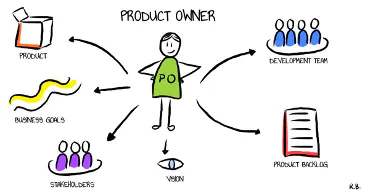
The term Product Owner is often used in the field of agile IT project management.
The Product Owner is one of the roles defined within the agile manifesto, and more specifically within the Scrum framework.
As a reminder: “agile methods describe a way of managing IT projects that favours dialogue between all stakeholders — clients, users, developers and other project professionals — flexibility during delivery, the ability to change plans and speed of delivery. The aim is to break with more traditional practices that are far too rigid and too demanding in terms of (contractual) specifications. To do this, it is important to prioritise relationships and extensive communication over development processes.”
Source: https://www.piloter.org/projet/methode/methode-agile.htm
A Product Owner is the person responsible for maximising the value of the product resulting from the development team’s work.
You can consider the Product Owner (PO) to be the person who will be responsible for the product’s success, from design to development. The projects in their charge are most often digital tools (software, apps, websites…).
The PO is the one who analyses the clients’ needs. They must make the final product as functional as possible to meet their expectations. They therefore know what the final product will look like, since they are the one who draws up the list of all the user requirements.
This list is then communicated to the development team in the form of a prioritised list of tasks called the product Backlog.
A PO is not an expert in processes or information systems. That’s why they need to work with the development team.
The PO is therefore the one who manages this product backlog.
As a reminder: a project run in agile mode is broken down into several product increments. The whole project is organised around iterations/sprints to develop these increments.
The PO therefore works in an orderly way, subdividing the creation process into iterations, according to the budget and time limits allotted.
As long as the client isn’t satisfied with the product, you can keep producing increments aimed at continuing to improve the product.
The PO is therefore a fully fledged member of the team. They are not the team’s manager. However, they are actively committed to the team’s well-being.
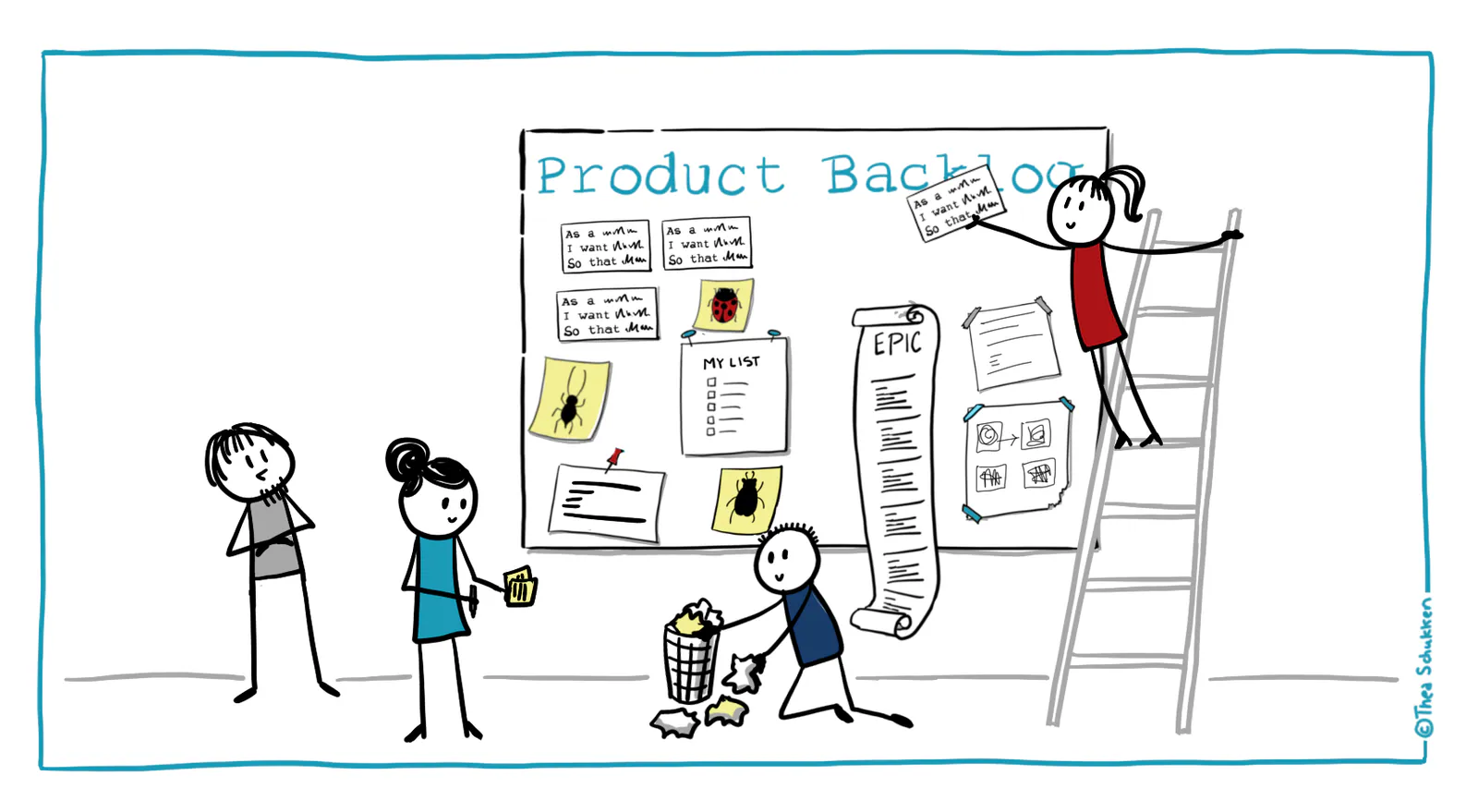
They must be available to communicate as much as possible with team members and with stakeholders. When talking with them, the PO takes the opportunity to pin down their needs and expectations in order to improve the product’s added value.
Unlike the project manager, the Product Owner therefore does not build the product as such. It’s the developers who handle its design. Nor does the PO plan the work of their colleagues, except in exceptional cases. Nor is the PO the guarantor of the content of deliveries.
The PO is therefore not responsible for the team’s performance or for HR processes.
They don’t arbitrate between teams and don’t decide on the resources allocated to the product.
Their job is to be a member of the product team and to work so that the team reaches its goal with the resources available.
What is their role?
In addition, the PO has many day-to-day tasks and responsibilities. However, these tasks vary a great deal and follow a fairly strict schedule.
Like the development team, the PO sees their days change over the course of the iteration.
Here are some of their tasks during an iteration:
· The PO must maximise the product’s value for clients, users and the organisation. They are the one who gathers feedback, prioritises it and fits it into the next iterations. The PO is not, however, the team’s secretary.
· They are also responsible for return on investment, the budget and the total cost of the product.
· They are responsible for managing the product backlog. They are therefore in charge of writing and organising the backlog’s content. For example, they are the one who must prioritise certain backlog items and make sure the backlog is clear to the whole team.
· The Product Owner is responsible for stakeholder management. They must therefore
discuss the current state of the product backlog and the next objectives to pursue. They are also the one who discusses planned delivery dates.
I’d like to end this article with one last point that I find interesting: the emergence of a new role within agile companies, the proxy product owner.
Proxy product owner: between project manager and product owner?
A proxy product owner is the product owner’s representative for a specific team.
The Product Owner chooses them personally, to help with certain tasks. They often help the PO lighten their workload within a specific scope.
Indeed, the Product Owner is the only person responsible for a product and has to work with several development teams on it. Managing everything can be complicated:
planning, sprints, meetings, etc.

In some cases, the Product Owner may need help working on the backlog with the development team. This also means answering team members’ questions without too much delay.
Introducing a Proxy Product Owner can help maintain the pace of work and increase the speed at which product increments are delivered. They will work closely with the team, making sure the product backlog is clear and well ordered and that all agile ceremonies are run properly, so as to be as effective as possible and maintain the quality and value of the product.
What is their role?
- They must communicate with the people involved in the project,
- They must make decisions about a product and the people developing it,
- They must gather clients’ needs,
- They must define and order the product backlog,
- They must plan how to deliver the backlog with the team,
- They must decide when product increments can be made available to clients.
It should still be noted that the Product Owner always remains responsible for the product and its success! Consequently, it’s always up to them to make the final decisions.
What are the advantages of a Proxy Product Owner (PPO)?
A proxy product owner can bring several advantages. Here they are:
- Improved communication within the Scrum team,
- Continuous availability of the business context for the team,
- An opportunity to build personal relationships,
- A positive influence on team motivation,
- Giving clients a positive, credible image of the company thanks to the continuous presence of the PPO following operations.
Having a PPO close to the development team means you can quickly answer any questions that come up.
What are the drawbacks of a proxy product owner?
There are, however, certain limits and risks posed by a Proxy Product Owner.
Here are the main drawbacks:
- The Proxy Product Owner is not the owner of the product. They don’t make the main decisions about the product and aren’t really responsible for its success, which can prove frustrating for them.
- They don’t control the product’s budget,
- They define neither the product vision nor its strategy,
- They don’t have the final say on the backlog and its items.
It can therefore be difficult to introduce a role like this within a project, because the PPO may in a way want to take on all the responsibilities and decisions and so replace the PO. This role can be complicated to manage because you are only a “representative” and not a “decision-maker”.
Ultimately, a PPO is often useful when the PO is overwhelmed and can’t manage everything. Otherwise, under normal circumstances, a company doesn’t necessarily need one. It all depends on the PO’s workload.
In conclusion
Project managers and Product Owners are therefore two distinct jobs, even if they sometimes use similar skills. That’s why they shouldn’t be used interchangeably within a company.
It is therefore important to understand the roles and responsibilities of each within a company in order to bring in the right people and the right skill sets where they’re needed.
What’s more, we can see new jobs emerging, such as the proxy product owner, which complements the product owner. Companies’ needs evolve and change. Certain jobs appear to fill that need.
So there are more surprises to come!
And yes, that’s already the end of this article. Don’t panic, we’ll be back very soon with even more content :)
The Dgitags team nevertheless hopes this article has interested you and taught you a few things about the jobs of product owner and project manager.
If you need advice or experts, our teams are here for you — don’t hesitate to get in touch.
Our services:
- Our developer studios
- SEO by Donutz
- SEA by Donutz
- A network of freelancers who are experts in their field (design, web marketing, product)
See you soon!
Sources: