
The Hub blog
Life as a Digital Nomad
One study shows that by mid-2020, the digital nomad population in the United States had exploded by 50% compared with 2019, rising from 7.3 million to 10.9 million.
It’s true that the term “digital nomad” often makes us think of an expat in the Bahamas, working in the sun in a hammock, a computer in one hand and a Margarita in the other. A bit of a cliché, isn’t it?
However, today, with Covid-19 and the spread of remote working, a growing number of people could adopt the digital nomad lifestyle, and not just young workers dreaming of travel and adventure.
On a global scale, we’re seeing the emergence of a new group of itinerant and remote workers. Most traditional companies are trying to reconcile a new model that combines days in the office and days working “remotely”.
In this article, we’ll introduce you to digital nomad life through a portrait of Jeremy Gerault, 29, who has been working as a freelancer with Donutz Digital for 8 months.
If you’re interested, read on!
A digital nomad: what is it?

“Digital nomads are people who are location-independent and use technology to perform their job, living a nomadic lifestyle. Digital nomads work remotely, telecommuting rather than being physically present at a company’s headquarters or office. The digital nomad lifestyle has been made possible by several innovations, including content management software, cheap internet access through WiFi, smartphones and Voice over Internet Protocol (VoIP) to contact clients and employers. In addition, the growth of the ‘gig economy’ has also played a role”.
Source: Investopedia
According to Jeremy, a digital nomad is “someone who knows how to manage their time and their projects”. Being a digital nomad means “working from wherever you want, whenever you want, as long as you satisfy your clients in terms of client relationship and performance”.
Jeremy’s portrait: how did he become a digital nomad?
1/ Career path and first jobs
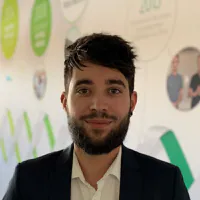
Jeremy Gerault did a master’s in marketing at the ESG business school. He had the opportunity to do his master’s as a work-study programme in a communications agency as a community manager. As a result, he became interested in the technical side of social media.
Once his work-study placement and studies were over, Jeremy decided to spend a year travelling in Latin America. On returning from his road trip, he was hired into the Social Media Ads unit of another web marketing agency.
After 3 months of training, he started managing his first clients. He worked on the paid side of Facebook Ads, which he really enjoyed.
“I love my job because I see it as a game of strategy and thinking”
After 2 years at this agency, he wanted to set off on an adventure again.
2/ How did he become a digital nomad?
The working model offered by his agency no longer matched what he wanted at the time. He wanted to go back and live abroad for a while.
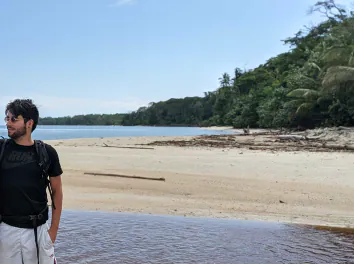
So Jeremy set up on his own and became a freelancer.
This decision allowed him to leave for 5 months in Costa Rica and to become a freelancer for Donutz Digital. Marie Joseph, the co-founder of Donutz, was looking for someone to develop the Facebook Ads unit. Jeremy’s only condition was being able to work remotely so he could travel freely.
And that’s how Jeremy began his life as a digital nomad.
3/ How do you organise your life as a digital nomad?
For 5 months, Jeremy worked from Costa Rica as a freelancer for Donutz digital.
He devoted 2 days a week to his work for our agency.
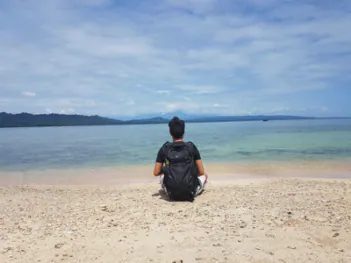
“I was a kind of crash test for Donutz. Marie Joseph’s ambition is to build a fully remote organisation. After talking it over, we told ourselves it was a good test, and that we’d see whether this model would work. We’d talked to the clients about it, and they didn’t really mind, as long as the work got done. You just have to be organised. Depending on the country I was in, I looked for hours that overlapped with France so I could contact clients if needed. When I was in Costa Rica, for example, I got up quite early, so it was doable.”
Jeremy found advantages in not having the same working hours as his Donutz colleagues: “at Donutz, we often work in pairs. I work with the social ads team. I’m training Sonia on Facebook Ads. So sometimes, if Sonia had a problem with a client at the end of the day, when she’d finished working, she’d tell me and I could take over quickly afterwards, since I got up a few hours later”.
What are the pros and cons of life as a digital nomad?
The pros
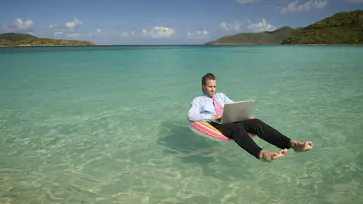
- Freedom to move around: if you love travelling, this lifestyle could really suit you. Geographical freedom is the main advantage of digital nomad life. You can travel whenever and wherever you want without having to sacrifice your professional life. As long as you have an internet connection and it isn’t a problem for your clients, there’s no real issue.
- Freedom of schedule: as a digital nomad, you can set your working hours and your availability.
As Jeremy put it: “I’m lucky to be able to organise my work around my needs”.
Digital nomads who manage their schedules well generally have a calmer pace of life. - Freedom to choose your clients and engagements: digital nomad life gives you the advantage of choosing your clients, your projects and your working pace, since you’re your own boss.
As Jeremy points out: “I can limit the number of projects I take on to leave myself a bit of free time”.
The cons
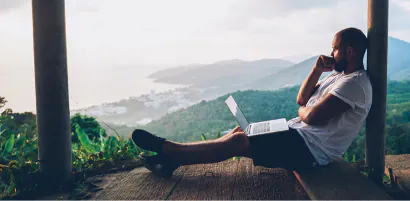
However, even if living the life of a digital nomad is synonymous with freedom, this lifestyle has a few drawbacks:
o Irregular income: the digital nomad is generally a freelance worker. Their income can therefore vary depending on their number of projects or clients. Some months can bring in more than others.
o No home base: it can be hard to keep changing city, or even country. The relationships and ties you build end up being very short-term. That can create a kind of instability. Nomadic life therefore involves fleeting social relationships and so the impossibility of building a stable private life. It’s not always the case, but it often can be.
o Isolation: most people build social ties at work. Being a digital nomad often means working alone in front of your screen. You generally don’t have colleagues, and if you do, you see them through a screen during meetings. Yet having good social relationships is essential to personal development for many people.
Jeremy seems to have found a way to counter this feeling of isolation:
“At Donutz, we have a weekly meeting every week. It’s an opportunity for me to keep social ties. You can quickly feel lonely when you work freelance. For example, it’s sometimes hard to stay informed about Facebook news, industry news, etc. You don’t have colleagues to keep you posted. That’s why, with friends from the sector, we organise a monthly catch-up once a month. It’s an opportunity for us to share what’s new or the difficulties we’ve encountered. It helps us stay connected and keep informed”.
Indeed, we can clearly see that digital nomad life has many advantages but also drawbacks. It is, however, possible to counter some of them, for example by trying to maintain social ties.
Can anyone become a digital nomad?
At the risk of disappointing you, the answer is clearly no.
According to Jeremy, “this model isn’t suited to everyone”. The question is: why?
Quite simply because you “have to manage to impose a rhythm on yourself. You’re often alone, so you need to know how to motivate yourself”.
The key to becoming a digital nomad is probably organisation and motivation. You have to manage to get up and motivate yourself every morning, because you’ll often be alone.
For example, Jeremy works “in blocks”. He gives himself time slots each day when he works “flat out”.
If we dig a little deeper, it’s true that being able to travel and work remotely in another city or country is a privilege, which explains why widespread digital nomadism is out of reach for many.
For example, some workers can take their computer and work anywhere. But others can’t.
According to research by the consulting firm McKinsey: “60 to 70% of the workforce has no opportunity” to work remotely. Most people are “cutting hair, taking care of patients, working in a production environment with machinery or in a lab with specialised equipment”.
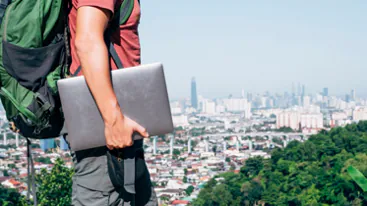
In reality, it’s mainly office workers with higher education who will have the opportunity to become digital nomads.
Some sectors will therefore have more digital nomads than others, quite simply because they can. After the pandemic, this phenomenon is likely to accelerate because people have broadly enjoyed remote working. Working conditions are generally more flexible, and you save time on commuting, gain sleep, etc.
However, a phenomenon that is likely to spread much more widely is hybrid work.
Companies are likely to introduce working schedules that require workers to come into the office from time to time while also being able to work remotely.
“Surveys conducted around the world have shown that most workers want to keep working remotely in some form, whether at home, in a cabin by the sea, on a ranch in a suburb much cheaper than the city they used to live in, or in another country altogether”, according to the BBC.
What are Jeremy’s future plans?
Jeremy wants to head off to Asia again in early January. He’ll continue working as a freelancer with Donutz. He might even like to get more involved in our digital agency.
He appreciates the open-mindedness of Hugo and Marie Joseph, who trusted him from the start and accepted his digital nomad lifestyle.
“They trusted me and gave me responsibilities.”
Conclusion
In conclusion, digital nomad life is one that may make some people dream, but it doesn’t suit everyone.
You need to be aware that this lifestyle offers great freedom, but you also have to take its negative aspects into account. It’s a life choice that will have major consequences on your professional and personal life.
We hope you enjoyed this article on digital nomad life. We’d like to thank Jeremy for the time he gave us.
We’ll be back soon with even more content :) Haven’t seen our latest article yet? It’s this way.
If you need advice or experts, our teams are here for you, don’t hesitate to reach out to them.
Our services:
- Our developer studios
- SEO by Donutz
- SEA by Donutz
- A network of freelancers, experts in their field (design, web marketing, product)
See you soon!
Sources:
- BBC
- Wikipedia
- Objectif Digital Nomad
- Interview with Jeremy