
The Hub blog
A visa for digital nomads?
In 2022, the digital nomad community numbers nearly 5 million people. This new way of working has encouraged some countries to create a new type of visa for these globetrotters.
If you’re planning to spend several months working in Bali, this article is for you ;)
Read on!
As a reminder, what is a digital nomad?
A digital nomad is someone who works remotely rather than being physically present in a company. Managing their professional activities online gives them the mobility to travel pretty much anywhere in the world.
Most of the time they live in hotels, guest houses, Airbnbs, coliving residences or even youth hostels. They can work almost anywhere as long as the WiFi connection is good enough: co-working spaces, cafés, hotels, etc.
As the name suggests, digital nomads often have a job related to digital. For example, they may be graphic designers, UX/UI designers, community managers, web developers, e-commerce managers, photographers, bloggers/influencers, consultants, etc.
If you’d like to find out more about the life of digital nomads, click here.
What is a digital nomad visa?
This type of visa is actually a travel permit that regularises the status of workers on the move.
It allows a digital nomad to work during their stay abroad, provided they do so independently and remotely.
To do this, the worker must prove that they really are a digital nomad and that they’re able to support themselves financially for the entire duration of their stay.
NB: a digital nomad visa is different from a tourist visa. A tourist visa is obtained for a tourist trip. You won’t be allowed to work in the foreign country in question. What’s more, a digital nomad visa will let you reside in the country for longer.
How do you get a digital nomad visa?
To get your digital nomad visa, you need to check with the country you want to travel to. Each country issues its own visa and has its own policies and regulations. In addition, the visa application process can sometimes involve fees. So it’s essential to understand properly how each country works.
For some destinations, you must submit the application in person at the embassy or consulate; this is the case for Estonia, for example. For other countries, you can apply online.
Most of the time, you’ll need:
- A valid passport meeting the requirements of the country in question,
- To own a company outside the country where you’re working as a digital nomad,
- Proof of regular income from abroad or proof of a deposit in a local bank,
- Proof of digital nomad travel insurance or health insurance.
Unfortunately, not all digital nomads are eligible for this type of visa, even if they can prove they work remotely. Eligibility will depend on the applicant’s nationality, their visa application history and whether they’re potentially seen as a threat to the security or health of the destination country.
If you meet all these criteria, there’s no reason for the visa to be refused.
NB: for many destinations, you’ll need to take out health insurance and repatriation assistance to obtain your digital nomad visa. For example, within the European Union, depending on the length of your stay, your medical costs may be covered by French social security (Sécurité sociale). You just need to request the European Health Insurance Card on the Ameli website or from your local health insurance office. Note that reimbursement of your medical costs abroad is based on French social security rates. The rest will be at your own expense. On the other hand, if you choose a country outside Europe, French social security doesn’t cover you (unless there’s a bilateral agreement between the countries).
Which countries grant them?
“Nomad-friendly” countries quickly understood the benefits of issuing this type of visa. Digital nomads contribute to the country’s economy. So it makes sense to make their travel easier with a suitable visa.
At present, more than 40 countries grant a digital nomad visa; here are a few of them:
- Spain grants visas valid for 12 months.
- Costa Rica grants visas valid for 24 months. It costs $550.
- The United Arab Emirates grants visas valid for 12 months. It costs $610.
- Germany grants visas valid for 36 months. It costs $100.
- Mexico grants visas valid for 12 months. It costs $45.
However, the conditions for obtaining the visa differ for each country.
For example, for Spain:
- You’ll need to show that you earn a monthly income of 2,151 euros or have 25,816 euros in a bank account,
- Have public or private health insurance authorised in Spain,
- Have a completely clean criminal record (in any country),
- Prove you’re in good health by presenting a valid medical certificate.
If you meet these conditions, you can apply for the visa before completing one month on Spanish territory. There will be a form to fill in, documents to attach and a fee of 10.72 euros. You’ll get an answer within 3 months of your application.
Other countries, such as the Czech Republic, may also ask you for proof of accommodation for at least one year.
Obtaining a visa therefore varies a great deal from country to country. So make sure you do your research beforehand.
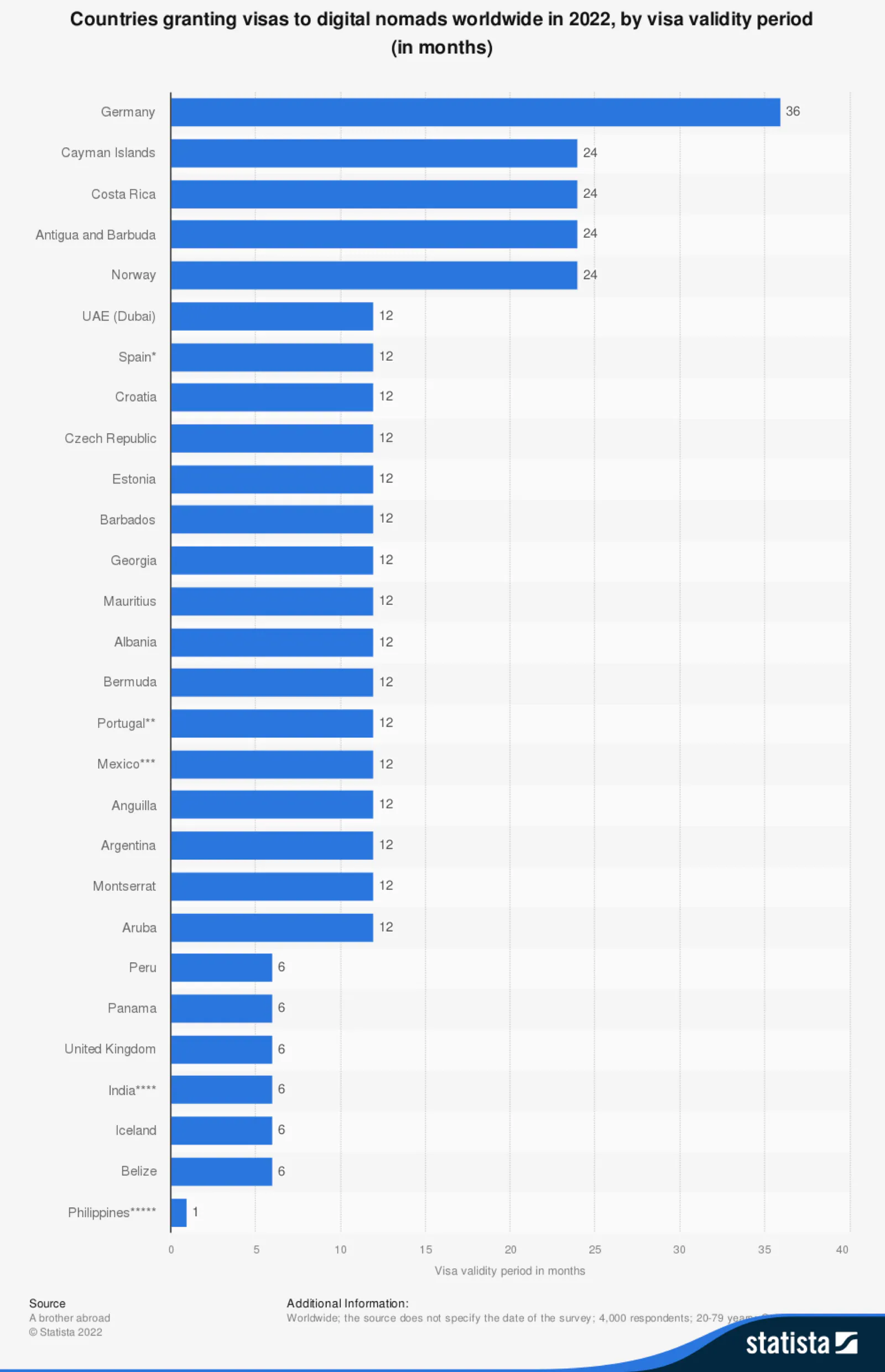
Countries granting visas to digital nomads worldwide in 2022, by visa validity period (in months).
What’s more, depending on the country, you may find tax advantages. If you want to benefit from them, you must officially relocate to the country in question; living there for a few months won’t be enough. You have to pay your taxes in France if you own a home in France, spend more than 6 months a year there or if your company’s registered office is based in France.
Here are a few examples of countries that will let you benefit from tax advantages:
- Croatia: you can benefit from a total tax exemption locally. To do so, you’ll need to become a tax resident in Croatia by registering with the local authorities (within 3 months of settling there).
- Costa Rica: not only can you benefit from a renewable one-year visa, but also from an income tax exemption and a duty exemption on imports of equipment needed for your activity. The condition for benefiting from this is having a monthly income above $3,000.
- Panama: if you apply for permanent residence in the country, you’ll only be taxed on your Panamanian income.
Getting your digital nomad visa isn’t always easy, as it requires a certain number of supporting documents. However, it’s becoming more and more widespread, which helps remove some of the barriers linked to the nomadic lifestyle.
To wrap up this article, the dgitags team wanted to share a few worldwide events dedicated to digital nomads:
- Digital nomad cruise: one of the biggest events for digital nomads, both in terms of participants and duration. The event takes place on a cruise ship for 10 days.
- Freedom Xfestival: a week of varied activities in a location that changes every year.
- Nomad Summit: it takes place every year in October. You can take part in talks, workshops and networking sessions.
- 7in7 : already 7 conferences on 7 continents in 7 years! This event isn’t for beginners but for experienced digital nomads. You need to have been a digital nomad for at least 3 years to take part.
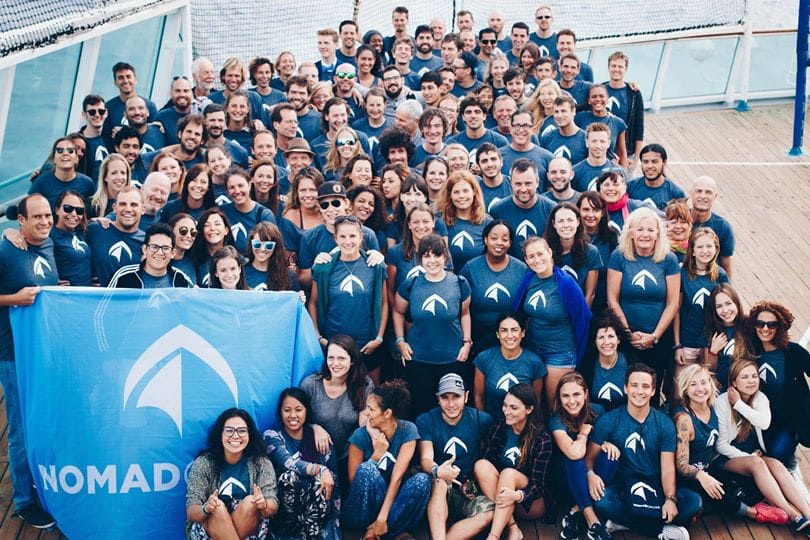
These fairs, festivals and conferences are a good way to meet other digital nomads, share experiences and build a network all over the world. Don’t hesitate to sign up!
We hope you enjoyed this article and that it has given you some useful information for applying for your digital nomad visa.
If you need advice or experts, our teams are here for you, so don’t hesitate to get in touch.
Our services:
- Our developer studios
- SEO and SEA by Donutz
- A network of freelancers, experts in their field (design, web marketing, product)
See you soon on dgitags.io!
Sources: